



Cell Growth Performance Testing
To assess whether reconditioning affects the cell-culture properties of polystyrene 6-well plates, we evaluated three parameters: cell morphology, cell confluence, and cell viability, using Rat-1 fibroblast cells as a model.
Plates were subjected to up to five reconditioning cycles. After each cycle, two plates were set aside, and the remaining plates were reseeded and returned for reconditioning. Once all cycles were complete, all plates (including two new plates as controls) were seeded simultaneously from the same cell culture to minimize variability and allow direct comparison.
Confluence and morphology were assessed by phase-contrast microscopy at 4x and 40x magnification. Confluence was quantified from 4x images using ImageJ, while morphology was analyzed from anonymized 40x images by measuring cell area, aspect ratio, and Feret’s diameter on 10 randomly selected cells per image. Cell viability was measured using a Trypan blue exclusion assay with an automated cell counter, from two replicates per plate.
For full methodology and detailed results, see our published study: Mansouri et al., 2026 — npj Materials Sustainability
Similar tests were also performed on T-75 flasks treated for cell culture, petri dishes, and 12-well plates treated for cell culture.
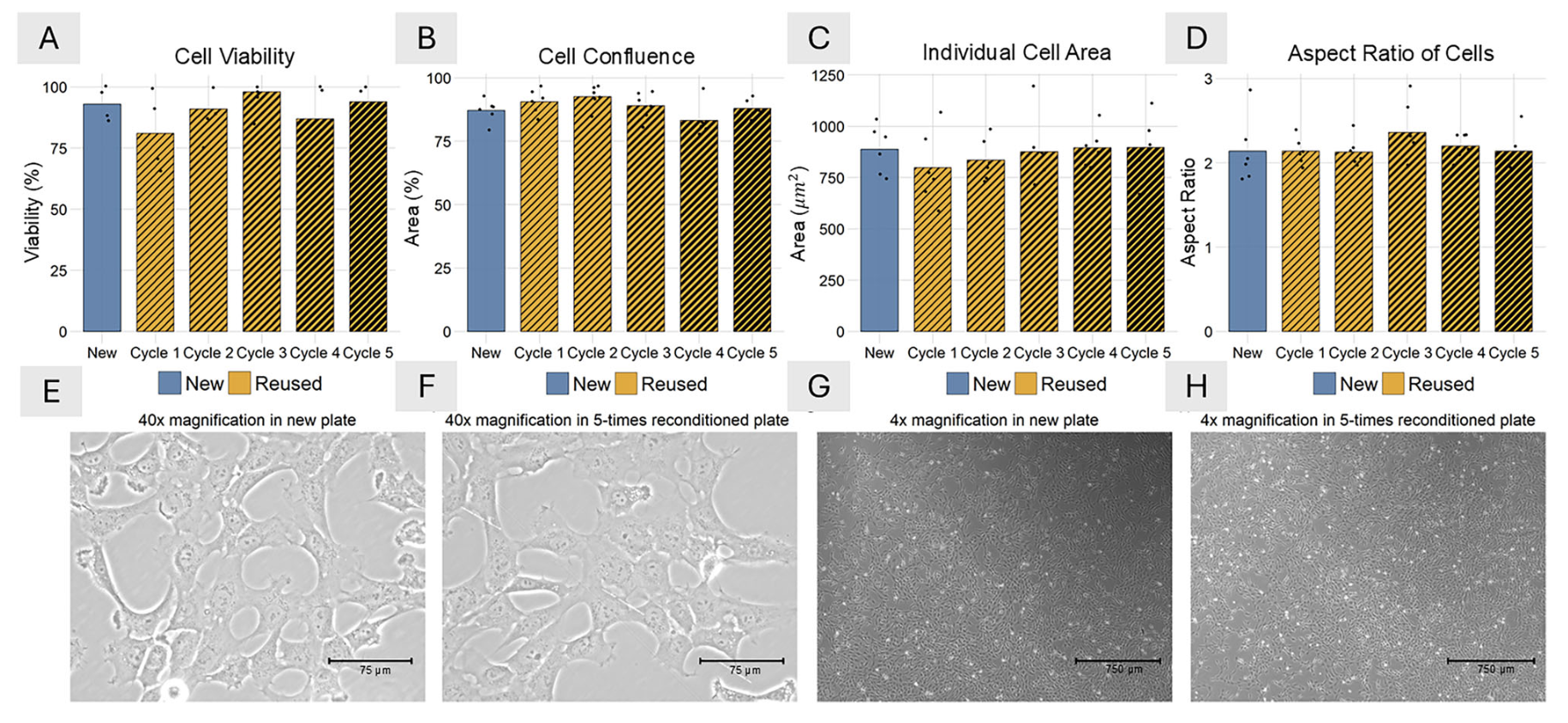
Results of seeding Rat-1 fibroblasts in new and reconditioned (up to 5 times) plates.

Results
Reconditioned plates supported cell growth comparable to new plates across all measured parameters. Cell viability averaged 93% in new plates and ranged from 81% to 98% across reconditioning cycles. Confluence averaged 87% in new plates and 83–93% in reconditioned plates. Individual cell area averaged 889 μm² in new plates and 798–898 μm² in reconditioned plates, while aspect ratios were nearly identical between conditions. Microscopy images showed no apparent differences in cell morphology or distribution between new and plates reconditioned up to five times. No statistically significant differences were observed for any of these parameters.
Variability was consistent across both new and reconditioned plates, and did not affect the overall conclusion: the reconditioning process had no significant impact on plate surface performance. Our process therefore allows the use of consumables that are reconditioned up to five times for cell passaging and seeding. Note that this conclusion applies to consumables with a chemical surface treatment, excluding those with a biological surface treatment, such as collagen-coated consumables.
These findings are consistent with prior research. Trusler et al. showed that reusing culture vessels across multiple passages did not affect human pulmonary fibroblast morphology, proliferation, or viability (Front. Sustain., 2024). Similarly, Clancy et al. reported that reusing culture dishes in Xenopus laevis embryo experiments yielded comparable fertilization and survival rates relative to new dishes (Differentiation, 2023). Together, these results support the feasibility of reconditioning single-use labware without compromising experimental reliability.