



Blood and beer residue analysis
FTIR is a technique for determining the chemical bonds present on the surface of the sample studied. By comparing the spectrum of a new consumable and that of a reconditioned consumable, we can determine the presence of residue on the surface of the plastic. It was here used to analyse the surface of 50 mL conical polypropylene tubes previously containing either blood or beer.
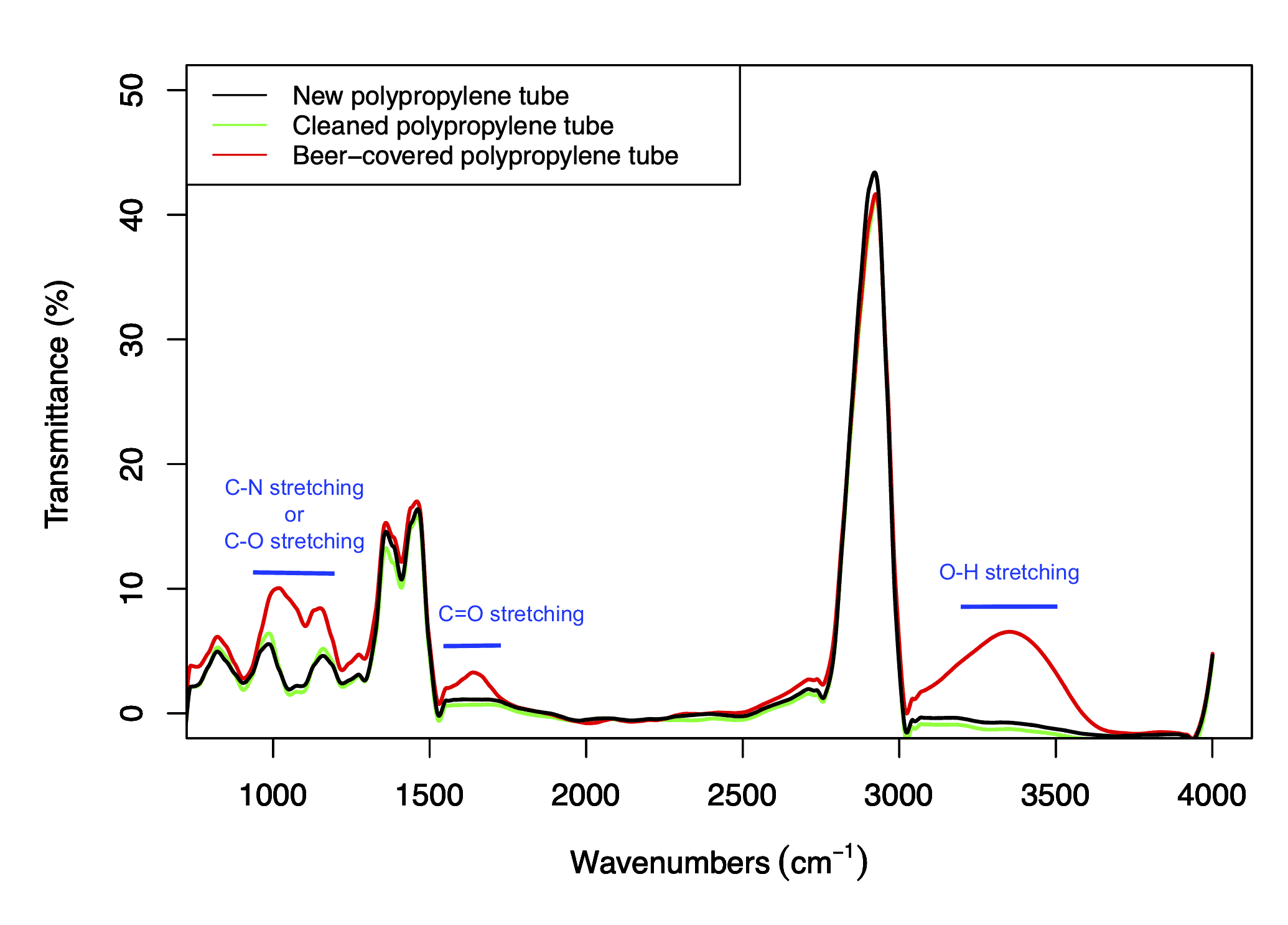

Beer residue testing
We observe that the spectrum of the new tube is characteristic of polypropylene, as expected. The spectrum of the tube containing a beer residue shows peaks additional to those characteristic of polypropylene. These infrared absorption peaks are typical of O-H, C=O and C-N or C-O groups, all present in beer. Finally, the reconditioned tube is in all respects similar to the new one, indicating the absence of the O-H, C=O and C-N / C-O groups in detectable quantities.
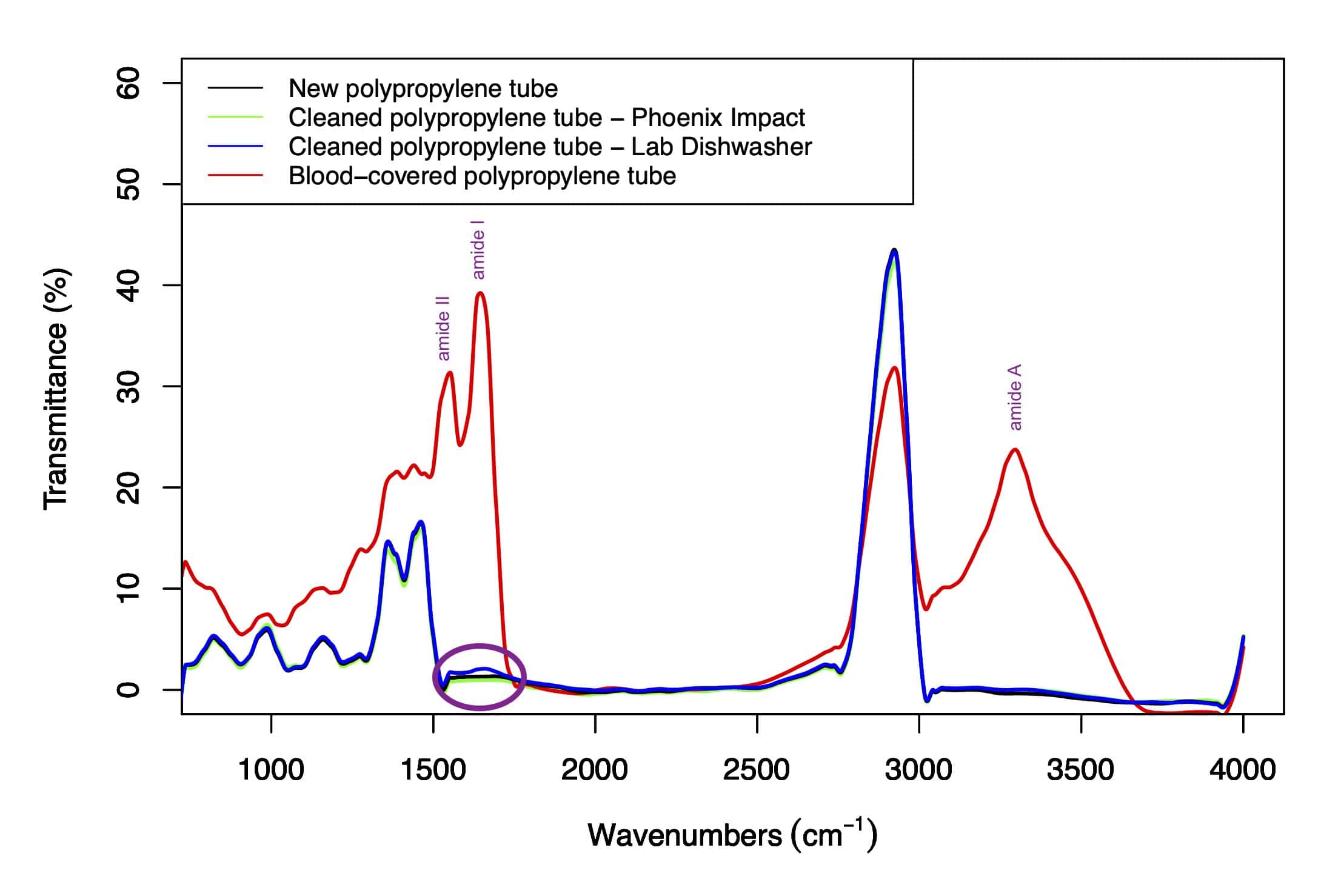

Blood residue testing
We observe that the spectrum of the new tube is characteristic of polypropylene, as expected. The spectrum of the tube containing blood residue shows the typical spectrum of blood. The reconditioned tube is in all respects similar to the new one, indicating the efficacy of the process to remove proteins (indicated by amide I, amide II, amide A, amide B, C-OH and COO stretchings), lipids (indicated by CH2, CH3 and C=O stretchings), nucleic acides (indicated by PO2 stretchings) and carbohydrates (indicated by CO-O-H stretchings).
During this experiment, a lab dishwasher using an enzyme cleaner was also used. One can see that this process did not allowed a complete removal of the amide I and amide II compounds, suggesting that some proteins remain after the cleaning. Our process therefore appears more suited for the cleaning of blood present on PP plastic than enzyme cleaning.