



Reconditioned cuvettes for absorbance test
To assess whether reconditioning affects the optical properties of polystyrene semi-micro cuvettes, absorbance measurements were compared between new and reconditioned cuvettes across five reconditioning cycles.
Four solutions were tested: three concentrations of potassium dichromate in perchloric acid (20, 120, and 600 mg/L), a well-established UV absorbance standard, and one aqueous Eosin Y solution, commonly used for visible-range linearity assessment. Each solution was measured at its characteristic wavelength (350, 430, or 517 nm). Five cuvettes per solution were set aside after each reconditioning cycle and tested alongside five new cuvettes as controls. Each cuvette was measured first filled with Milli-Q water as a blank, then filled with its respective solution.
For full methodology and detailed results, see our published study: Mansouri et al., 2026 — npj Materials Sustainability
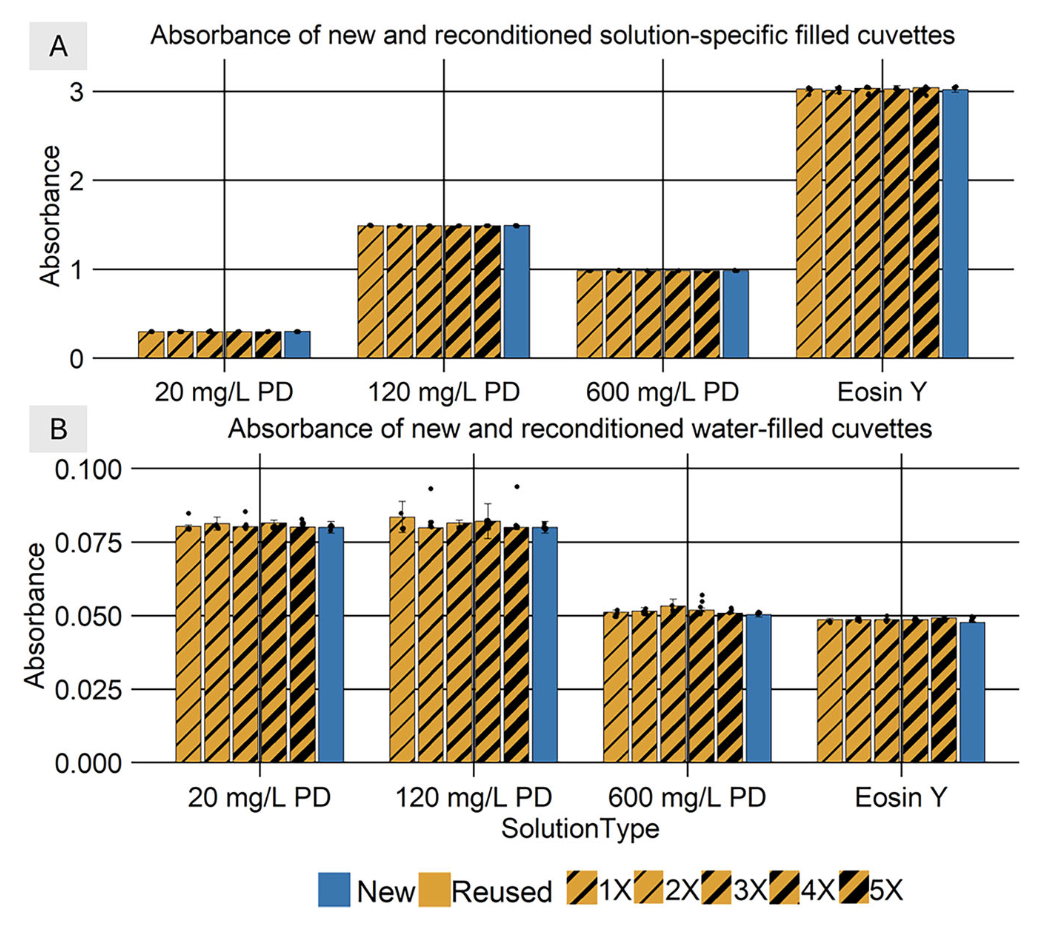
Absorbance measurement results in semi-micro cuvettes using specific solutions and Milli-Q water. Results for the 20 mg/L and 120 mg/L potassium dichromate (PD) solutions are shown at 350 nm, while the 600 mg/L PD solution is shown at 430 nm and the Eosin Y solution at 517 nm.

Results
Reconditioned cuvettes produced absorbance measurements comparable to new cuvettes across all tested conditions. No statistically significant differences were detected between new and reconditioned cuvettes for either the solution-filled or Milli-Q water-filled measurements, across all five reconditioning cycles. Effect sizes varied slightly between conditions but showed no consistent pattern favoring either group, and standard deviations suggested no directional trend, indicating that observed variation likely reflects factors inherent to spectrophotometry such as solution preparation, handling, or measurement timing, rather than any effect of reconditioning.