



Protein quantification for a broad range of concentrations
The potential for reusing tubes in protein-based applications was evaluated through quantitative protein assays across a broad concentration range, from 0.5 to 2,000 μg/mL. Different assay formats and detection methods were investigated to assess performance across both low and high protein concentrations.
The results presented here include:
- Pierce BSA Protein Assay in microcentrifuge tubes: 25–2,000 μg/mL
- Pierce BSA Protein Assay in microplates: 5–250 μg/mL
- AccuOrange fluorescence assay in microcentrifuge tubes: 0.5–1 μg/mL
Reconditioned microplates and tubes for Pierce BCA protein assay
To assess whether reconditioning affects protein quantification accuracy, we performed the Pierce BCA assay using two formats: a microplate-based method (96-well polystyrene plates) and a tube-based method (1.5 mL polypropylene microcentrifuge tubes).
Three microplates and 18 tubes were subjected to five reconditioning cycles and reused to perform the assay after each cycle, compared against new consumables at every cycle. Both formats followed standard BCA protocols, with 9 concentration standards and a Milli-Q water blank run in each condition (from 5 to 250 μg/mL for plates, and from 25 to 2000 μg/mL for tubes). Absorbance was measured at 562 nm, and standard curves were generated for each condition. Blank absorbance, standard curve absorbance, and standard deviations were compared between new and reconditioned consumables to evaluate any effect on measurement accuracy and variability.
For full methodology and detailed results, see our published study: Mansouri et al., 2026 — npj Materials Sustainability
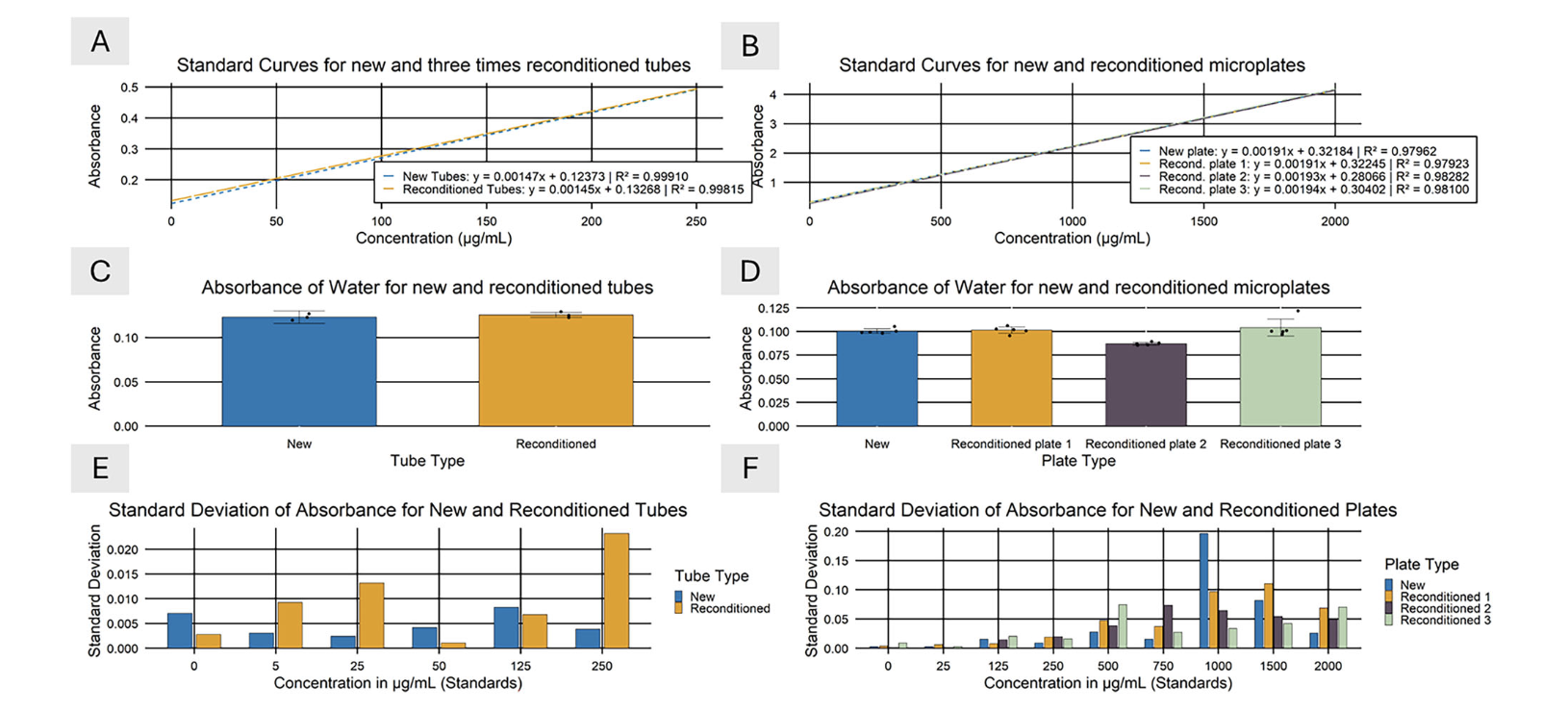
Protein quantification results in 96-well microplates and micro-centrifuge tubes using the BCA assay. Statistical analysis was performed using the Mann–Whitney U test with a Bonferroni-Holm correction. No statistically significant differences were observed. Each standard was tested in five replicates per plates for microplates and in three replicates for tubes (total of 18 tubes).

Results
Reconditioned microplates and tubes produced BCA standard curves comparable to new consumables across all reconditioning cycles. For tubes, R² values were consistently above 0.99 for both new and reconditioned conditions, and no statistically significant differences in absorbance were detected across any of the standards. The blank absorbance of reconditioned tubes was marginally higher than new tubes (by approximately 0.003 absorbance units), but this difference was not statistically significant. For microplates, R² values remained above 0.97 in all conditions, and no statistically significant differences in absorbance were detected across any of the standards.
Effect sizes and standard deviations varied slightly across standards and replicates in both formats but showed no consistent pattern favoring either group, suggesting that observed variation reflects normal experimental factors such as standard preparation, handling, or measurement timing rather than any effect of reconditioning.
These results support the safe reuse of microplates and microcentrifuge tubes for protein quantification, with no loss of accuracy or reliability across five reconditioning cycles.
Protein Quantification by Fluorimetric Assay
To determine whether reconditioning affects the accuracy of quantification of low protein concentrations, we performed fluorimetric assays of BSA (Bovine Serum Albumin) using the AccuOrange kit (Biotium) in 1.5 mL polypropylene microcentrifuge tubes.
Microcentrifuge tubes were subjected to a reconditioning cycle and then reused to perform the assays, in comparison with new consumables, for three brands (M1 Invitrogen Low-binding, M2 Corning, M3 FunChem). This experiment followed the standard protocol, with 5 concentration standards (0.5 to 1 μg/mL) and a Milli-Q water blank in each condition. Each condition was measured in three replicates. Fluorescence values from the calibration curves and coefficients of variation were compared between new and reconditioned consumables to assess any effect on measurement accuracy and variability.
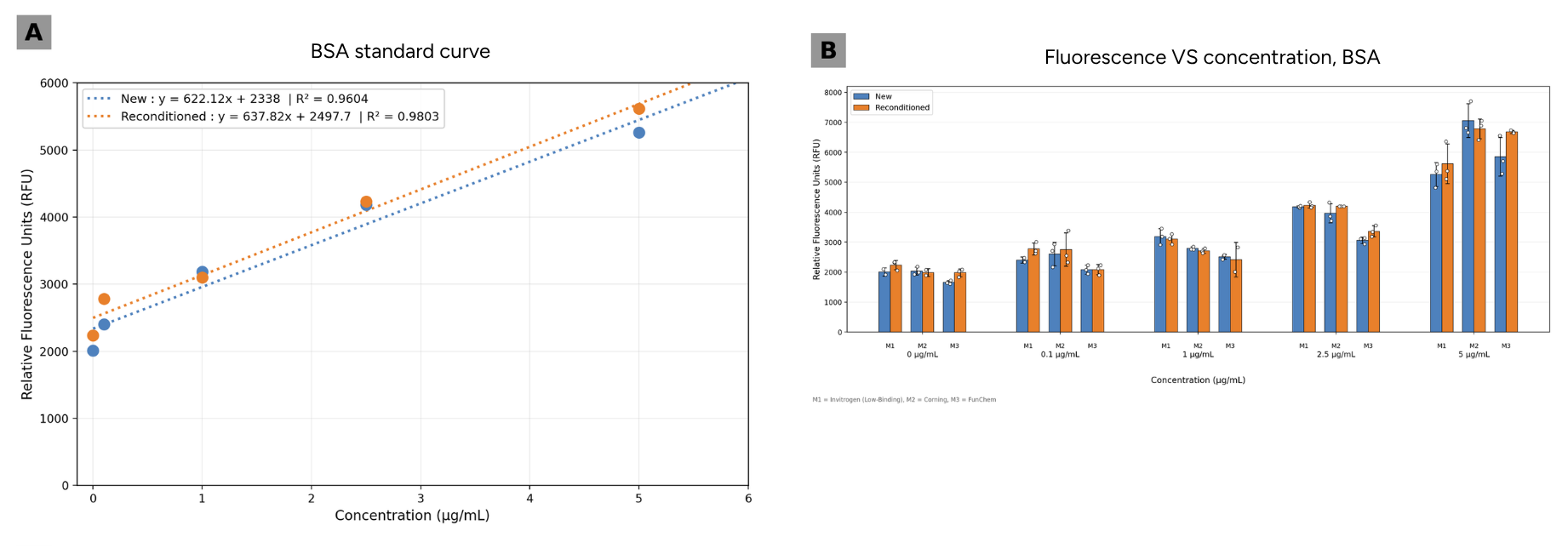
Quantification of BSA protein in microcentrifuge tubes using an AccuOrange assay. No significant difference was observed. Each concentration was tested in 3 replicates per condition.
Results
Reconditioned tubes yielded standard curves comparable to those obtained with new consumables (Figure A). R² values remained above 0.96 in both conditions, for both new tubes (R² = 0.9604) and reconditioned tubes (R² = 0.9803). No marked significant difference in signal was detected at any concentration (Figure B). The Low-binding brand (M1) showed no detectable advantage at low concentrations.
Deviations and coefficients of variation varied slightly from one replicate to another, but with no consistent trend favoring either group, suggesting that the observed variation reflects normal experimental factors such as dilution preparation, pipetting, and timing of measurement, rather than an effect of reconditioning. At the lowest concentrations, variability is dominated by instrumental noise as the kit approaches its limit of detection, rather than by a concentration-dependent adsorption phenomenon.
These results confirm that reconditioned microcentrifuge tubes can be reused for handling low protein concentrations, without loss of accuracy or reliability.