



Quantification of Low Concentrations of Plasmid DNA and Single-Stranded DNA by Fluorimetric Assay
To determine whether the reconditioning of microcentrifuge tubes affects the accuracy of nucleic acid quantification (in the ng and μg range), we performed fluorimetric assays on two types of DNA: double-stranded DNA (dsDNA), corresponding to the pCL7c plasmid (~5 kb), using the AccuBlue NextGen kit (Biotium), and single-stranded DNA (ssDNA) using the Helixyte Green kit (AAT Bioquest). Assays were carried out in 1.5 mL polypropylene microcentrifuge tubes for double-stranded DNA and 0.6 mL tubes for single-stranded DNA.
Microcentrifuge tubes were subjected to a reconditioning cycle and then reused to perform the assays, in comparison with new tubes: two brands in the case of single-stranded DNA (M1 Invitrogen Low-binding, M2 Corning) and three brands in the case of double-stranded DNA (M1 Invitrogen Low-binding, M2 Corning, M3 FunChem). Both formats followed standard protocols, with 4 or 5 concentration standards and a Tris-EDTA blank in each condition.
For single-stranded DNA, three distinct DNA samples were tested: Myt1 Reverse and Myt1 Forward, which are primers of approximately 45 bp, as well as 3XNLS-BFP-R, a DNA sequence encoding a blue fluorescent protein of approximately 800 to 1,100 bp. The concentrations tested ranged from 2.3 ng/mL to 2 μg/mL. The standard curves and graphs presented here correspond to Myt1 Forward, given as a representative example. For plasmid DNA, the concentrations tested ranged from 0.5 ng/mL to 0.3 μg/mL.
Each condition was measured in three replicates. Standard curves, means of the 3 replicates, and coefficients of variation (CV<14%) were compared between new and reconditioned consumables to assess any effect on measurement accuracy and variability.
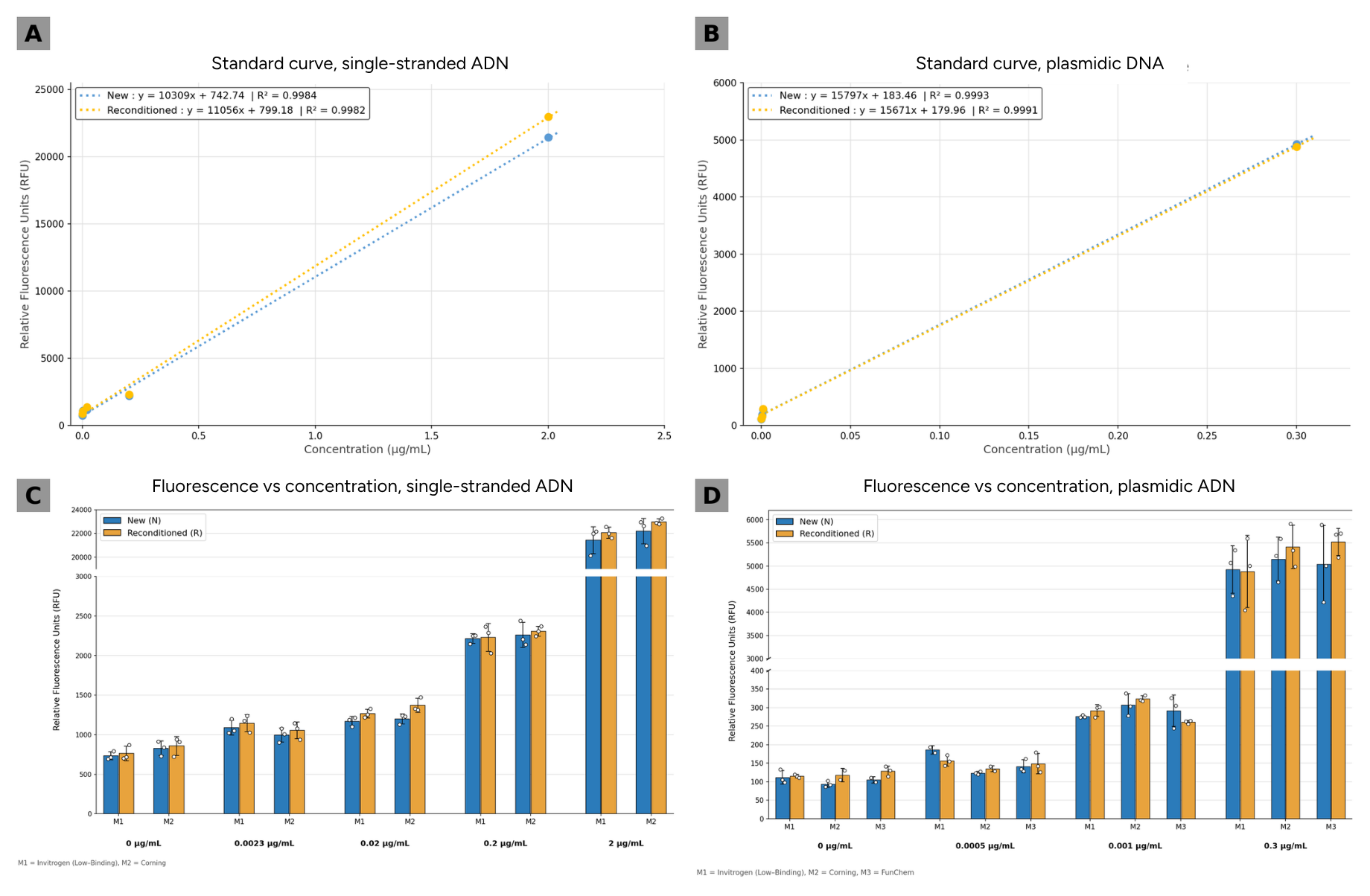
Figure 1. DNA quantification from new and reconditioned tubes. No significant difference was observed. Each concentration was tested in 3 replicates per condition.

Results
Reconditioned tubes yielded standard curves comparable to those obtained with new consumables, for both types of DNA (panels A and B). No marked difference in signal was detected for any of the standards, with very small deviations between conditions (panels C and D). The Low-binding brand (M1) showed no detectable advantage at the concentrations studied.
Deviations and coefficients of variation varied slightly from one concentration to another and from one replicate to another, but with no consistent trend favoring either group, suggesting that the observed variation reflects normal experimental factors such as dilution preparation, pipetting, or timing of measurement, rather than an effect of reconditioning.
At the lowest concentrations, variability is dominated by instrumental noise as the kits approach their limit of detection, rather than by a concentration-dependent adsorption phenomenon.
These results confirm that reconditioned microcentrifuge tubes can be reused for DNA quantification, both plasmid and single-stranded, without loss of accuracy or reliability, even at very low concentrations.